
SCALABRINI SIGNAGE
Scalabrini Village is a social project: It is, first and foremost, a response to the community's desire to preserve a place of worship and then responds to the City of Montreal's request to come and work on affordable housing for all. The project is based on the desire to transform a heritage church into a community center, and to add a new building with 51 housing units on the remaining plot. One of our main objectives was to create, at the heart of the new building, a tangible and strong link with the church and to allow dialogue and interaction between the different tenants.
CLIENT :
Scalabrinian Missionaries
Adriana Alfano, Eng.
LOCATION :
Montreal, QC
YEAR :
AREA:
2022
N / A
DISCIPLINE :
DESIGN GRAPHIQUE
PHOTO/3D:
Magalie Lafleur
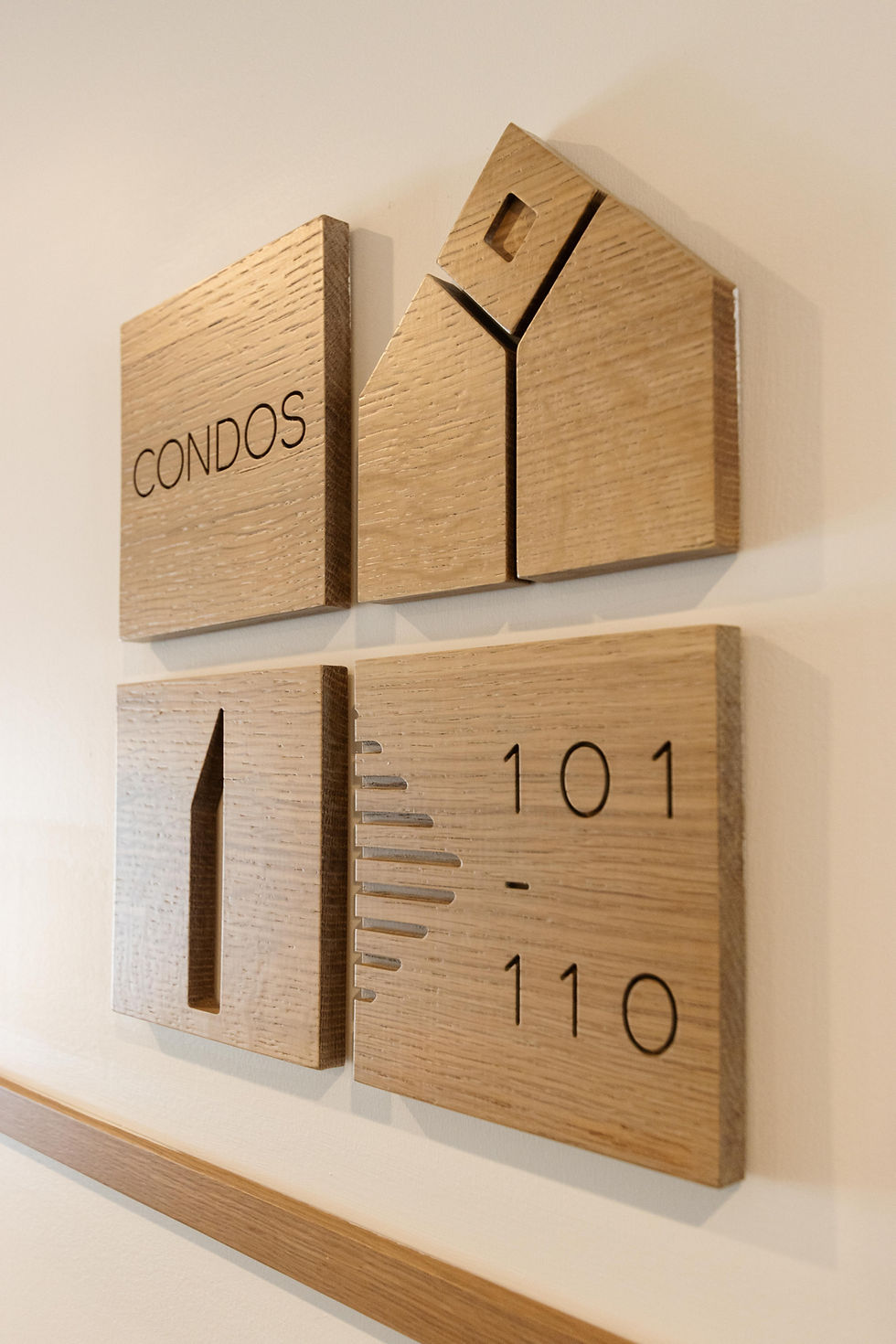
As this project has a community and social vocation, it was essential to create a friendly and warm atmosphere in the common areas, while optimizing a limited budget. This is how the design principles gradually turned to signage, which quickly became the cornerstone of the project's identity.


To finalize the identity of the site, the objective of this signage is to: enhance and recall the church by incorporating architectural elements into its form; create and anchor the project's identity, as the signage is one of the bridges between the church and the new building; and adorn the corridors, which were left bare due to budget constraints.
Scalabrini's signage is placed on the walls, like votive icons. Inspired by calendar icons called Menaions or Menologes: wooden frames, playing on the stacking and superposition of geometric elements, it symbolically recalls the discovery of a Stations of the Cross, and stylistically echoes the church's central stained-glass window.
It is available as apartment numbers, directional signage, and a large logo, also engraved in the solid oak plywood, this time echoing the entire shape of the church's main stained-glass window in the lobby.
Composed entirely of white oak plywood, its CNC cutting has three levels, and plays with relief and negative space, once again echoing the language of stained-glass windows, where the glass is cut from the solid, then reassembled. Our graphic design team hand-drew all the numbers, creating a custom typography: The stacking of shapes, like the stacking of plates, creates a typographic interplay that extends to the material, then to the space in which it is anchored.
